
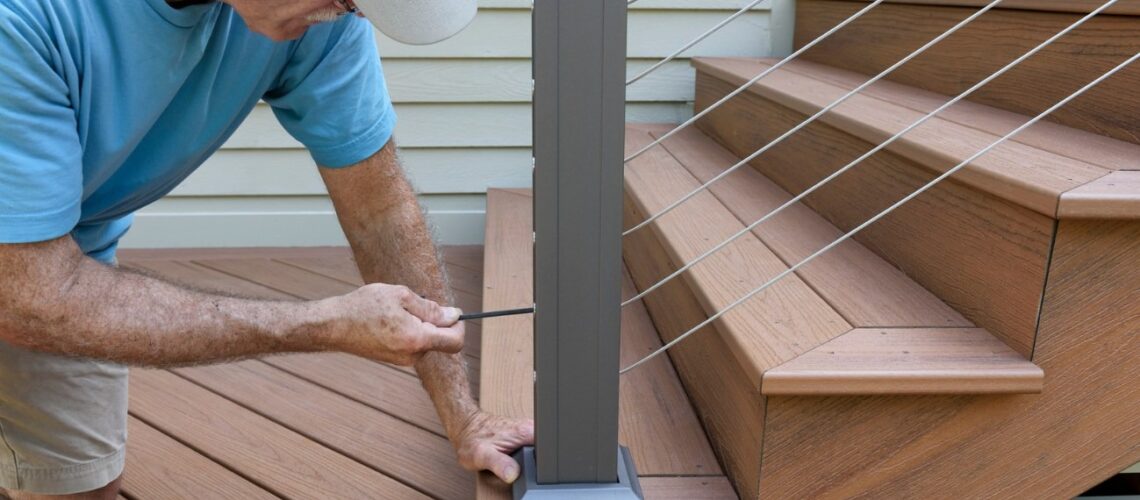

Your wood deck still feels solid underfoot, but the railing is grey, splitting and starting to wobble. You want a low-maintenance aluminum railing without paying to tear out a deck that has years left in it. The good news: on most structurally sound decks, you can replace only the railing. The real question is what happens at the posts and the rim joist, because that is where an old deck either supports a new guard or fails one.
This guide walks you through how to decide what stays, which retrofit option fits your deck, what Alberta’s railing rules require, and how to measure, order and install without the mistakes that cause wobbly posts or failed inspections.
Quick Summary
- Most wood decks with sound framing can take a new aluminum railing without a full rebuild.
- The deck surface is rarely the problem. The rim joist, the blocking under the posts and the wood posts themselves decide the job.
- There are three practical retrofit paths: full aluminum posts, aluminum sections between existing wood posts, or a partial framing repair before new railing.
- In Calgary, guards must be at least 0.9 m (36″) tall, or 1.07 m (42″) where the deck is 1.8 m or more above the ground, with openings no wider than 100 mm (4″).
- Stairs are the most common trouble spot on older decks because their angles rarely match off-the-shelf stair kits.
- Measure each run, deduct the deck-board overhang, and photograph the framing before you order.
- Removing the old railing first, then fixing what you find, avoids ordering for a deck you have not fully inspected.
Can You Keep Your Deck and Posts? What Actually Decides It
A railing is a structural guard. It has to resist people leaning, sitting and falling against it, so it is only as strong as what it is fastened to. Before you think about colours or picket styles, look at three things.
The framing under the railing
Aluminum posts with base plates are screwed down through the deck boards into the framing. If the rim joist is soft, split or missing solid blocking behind the post locations, a new post will rock no matter how good the railing is. Sound framing is the single biggest reason a retrofit succeeds.
The condition of the existing wood posts
Old wood guard posts are often bolted to the outside of the rim joist. After 15 or more Alberta winters, these connections loosen, bolt holes elongate, and the post bottoms rot where water collects. Keeping wood posts can work, but only if each one is solid at the base and firmly attached.
Deck height and code
Your deck’s height above grade sets the minimum guard height. The City of Calgary requires a 0.9 m (36″) railing when the deck surface is less than 1.8 m above the adjacent ground and 1.07 m (42″) at 1.8 m or more, with a maximum opening of 100 mm (4″). Many older decks were built with lower or more open railings, so a straight swap of the same height is not always compliant.
Permits matter too. Calgary requires a building permit to rebuild, extend or add stairs to an uncovered deck higher than 0.6 m (2 ft) above grade. Railing-only replacements are not listed separately, so confirm with the city’s deck permit page or the Planning Services Centre before you start, especially if you plan to repair framing or rebuild stairs.
Three Ways to Retrofit Aluminum Railings on a Wood Deck
Once you know the condition of the framing and posts, the choice usually narrows to one of three paths.
| Retrofit option | What stays | What gets replaced | Best when | Watch out for |
| Full aluminum posts and railing | Deck framing and boards | All wood posts, rails and balusters | Wood posts are loose, rotted or bolted to the side of the rim | Solid blocking is needed under every new base plate |
| Aluminum sections between existing wood posts | Deck, framing and wood posts | Rails and balusters only | Wood posts are solid, plumb and well attached, and you like the wood look | Posts will still need staining and eventual replacement |
| Partial framing repair, then new aluminum | Most of the deck surface and joists | Damaged rim joist sections, blocking, some boards, all railing | Soft spots are limited to the perimeter or around posts | Repairs may trigger a permit and add a few days |
Full aluminum posts give the cleanest result and remove wood from the guard entirely. McLean’s aluminum picket railing system uses 2″ x 2″ posts on 4″ x 4″ base plates reinforced with gussets, with pickets welded to the top and bottom channels.
Keeping wood posts is the lower-cost path when those posts are genuinely sound. McLean’s gallery includes picket and glass railing sections installed between wood posts, which shows the hybrid look is a real option rather than a compromise.
The partial repair path is common on decks around 20 years old, where the joists are fine but the perimeter has taken years of water and snow.
Not sure which path fits your deck? Request a quote from McLean Railings with your deck measurements and a few photos of the posts and rim joist.
The KEEP Test: A 4-Point Keep-or-Replace Framework
Use this framework before you request pricing. It takes about 30 minutes with a screwdriver, a flashlight, a level and a tape measure, and it tells you which retrofit option you are actually shopping for.
K: Knock and probe the wood
Push a flat screwdriver into each wood post at the base, the rim joist at every post location, and the end grain of the joists along the perimeter. If the tip sinks in more than about 6 mm (1/4″) with hand pressure, or the wood sounds hollow when tapped, mark it for replacement.
E: Examine the edge connections
Grab each post at the top and push outward. Any movement you can see or feel means the connection is failing. Check that the rim joist is fastened tightly to the joist ends and note whether there is solid blocking where a new base plate would land.
E: Establish the elevation
Measure from the deck surface to the ground at the lowest point next to the deck. Under 1.8 m means a 0.9 m minimum guard in Calgary; 1.8 m or more means 1.07 m. If your existing railing is shorter than required, plan for the new height rather than matching the old one.
P: Plot the stairs
Measure the total rise and run of each stair, and check whether stringers are solid and level side to side. Note any landing or turn. Stairs on older decks are often steeper or shallower than standard, which affects the stair railing you need.
Reading your results
- All four points pass: you are a candidate for aluminum sections between existing wood posts, or full aluminum posts if you prefer the look.
- Posts fail, but framing passes: plan on full aluminum posts with new blocking.
- Rim joist or blocking fails in limited spots: plan a partial framing repair first, then new railing.
- Joists fail across the deck: the railing is not your main project. Get the deck structure assessed before buying railing.
Step-by-Step Retrofit Checklist: From Assessment to Final Check
This sequence keeps you from ordering railing for a deck you have not fully inspected.
- Run the KEEP Test and decide on your retrofit option.
- Check permit needs with your municipality, especially if framing or stairs will be rebuilt.
- Measure every run. Record the overall length of each side, deduct the deck-board overhang, and mark every corner and the top and bottom of each stair.
- Photograph the framing at each corner and post location so your supplier can see what the railing will attach to.
- Choose height, style and colour. McLean’s standard colours are white, yard bronze and black, with custom powder-coat colours available. Standard railing height is 42″.
- Get a quote and confirm the parts list against your measurements before ordering.
- Remove the old railing once materials are scheduled, not months ahead, so the deck is not left unguarded.
- Repair and block the framing wherever the old posts revealed soft wood or no blocking.
- Lay out post locations, including corner posts, line posts and support legs, before cutting anything.
- Cut to size and assemble, installing pickets with the provided spacers to keep openings consistent.
- Seal penetrations at base plates with non-corrosive exterior caulking.
- Do a load and wobble check on every post and book an inspection if your project requires a permit.
McLean’s features and assembly guide show the layout, cutting and installation steps for picket, glass and stair railings.
Tools to have ready
- Circular saw with a carbide-tip blade
- Drill and drill bits
- Phillips screwdriver
- Tape measure and level
- Safety glasses
- Non-corrosive exterior caulking
Stairs: the part most retrofits get wrong
Big-box stair kits are commonly sold for a 45° angle, but stairs on older decks rarely match it. A mismatch leaves uneven gaps at the bottom rail or forces awkward cuts. McLean’s stair and ramp railing uses a pivoting picket system that sets to the slope of the stair, which suits older decks with non-standard rise and run.
Local Considerations for Calgary and Western Canada
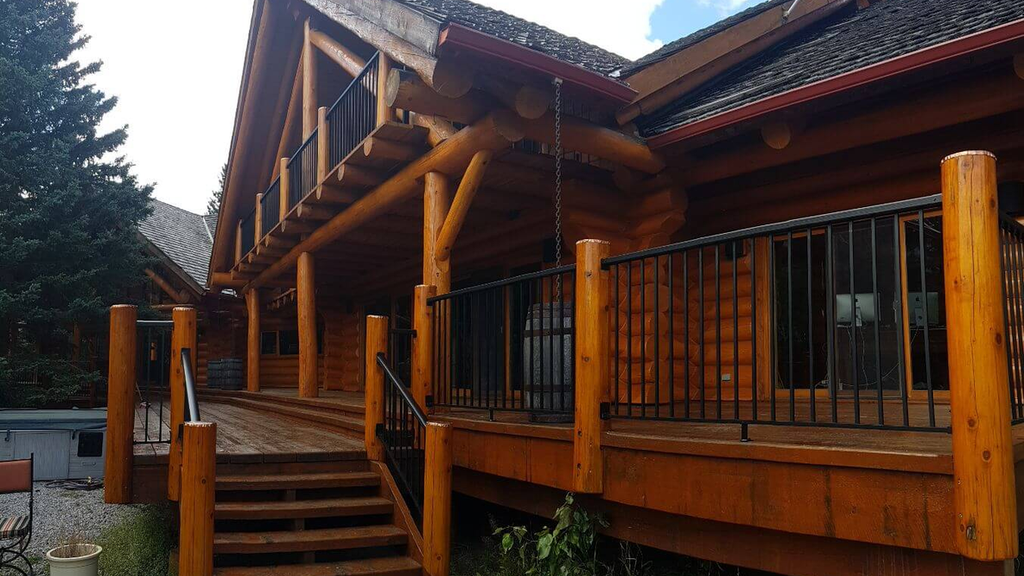
An aluminum retrofit in southern Alberta deals with conditions that coastal guides skip.
Weather and timing
- Freeze-thaw cycles: chinook swings can take a deck above and below freezing many times in one winter. Water that sits around post bases freezes, expands and loosens fasteners, so sealed base plates and solid blocking matter more here.
- Snow against railings: snow shovelled or drifted against pickets adds sideways load. Clear it rather than piling it on the railing run.
- Install season: most retrofits are planned for spring through fall, when framing is dry and exterior caulking cures properly. Booking an assessment in late winter helps you get ahead of the spring rush.
Logistics and service constraints
- Installation area: McLean offers installation in the Calgary area. Outside it, railings ship across Western Canada for homeowners and contractors to install.
- Complete packages: McLean’s railing packages include the hardware, so you are not sourcing brackets and screws separately.
- Receiving and storage: rails and posts arrive in long lengths. Plan a dry, flat spot in a garage or under cover until installation day.
- Cutting on site: sections are cut to your measured runs during installation, so accurate measurements and correct overhang deductions are critical.
- Hiring a contractor: if a contractor is installing for you, McLean also supplies contractors and home builders, so your installer can order directly.
Ready to price your retrofit? Get a quote from McLean Railings or call 403-995-0361 with your measurements and photos.
Common Mistakes
- Matching the old railing height. Older decks often have guards below today’s minimum. Measure the deck height and size the new railing to code.
- Keeping posts that only look solid. Rot usually starts at the base and inside bolt holes. Probe every post, not just the ones that look worn.
- Screwing base plates into deck boards alone. Deck boards are not structure. Base plates need solid framing or blocking underneath.
- Forgetting the overhang deduction. Measuring to the outer edge of the deck boards makes runs too long for the post layout.
- Ordering before removing the old railing. Hidden rot behind old posts can change the plan after the order is placed.
- Using a 45° kit on a non-standard stair. It leaves uneven gaps and can push openings past the 100 mm limit.
- Skipping the sealant. Unsealed fastener holes let water into the framing, which is the same problem that wore out the old railing.
What To Do If Something Goes Wrong
A new post wobbles after installation
Stop using that section. Check underneath for missing blocking or soft wood around the fasteners. Add solid blocking, move the plate onto sound framing if needed, and reinstall with new fasteners.
You find rot after the old railing is off
Leave the area guarded or blocked off and do not install new railing over it. Cut out and replace the damaged rim joist or blocking first, then confirm whether the repair needs a permit.
A run comes up short or long
Re-measure from post centre to post centre and recheck the overhang deduction before cutting more material. Contact your supplier with the corrected numbers before improvising extra cuts.
Gaps at the stair rail look too wide
Check the openings with a 100 mm (4″) object. If it passes through, adjust the stair section angle or bottom rail position before the deck is used.
An inspection fails
Ask the inspector for the specific code item and measurement. Most guard failures come down to height, opening size or post attachment, which can usually be corrected without replacing the railing.
FAQ
Can I install aluminum railing on an existing wood deck?
Yes, as long as the framing is sound. Aluminum posts fasten through the deck boards into the rim joist or solid blocking, so the structure under each post must be solid. Decks with widespread joist rot need structural repair first.
Can I keep my wood posts and add aluminum railing sections?
Yes, if each wood post is solid at the base, plumb and firmly attached to the framing. Aluminum picket or glass sections can be installed between them. Posts that move when pushed or show rot should be replaced.
How tall does a deck railing need to be in Calgary?
The City of Calgary requires a 0.9 m (36″) railing when the deck surface is less than 1.8 m above the ground, and 1.07 m (42″) at 1.8 m or higher. Openings in the railing cannot exceed 100 mm (4″).
Do I need a permit to replace my deck railing in Calgary?
Calgary requires a building permit to rebuild, extend or add stairs to an uncovered deck more than 0.6 m above grade. Railing-only replacement is not listed separately, so confirm with the city before starting, particularly if framing or stairs will be rebuilt.
Will aluminum railing fit my old deck stairs?
It can, but stair angle is the most common fit problem on older decks. Many off-the-shelf stair kits are made for 45°, while a pivoting picket system can be set to the actual slope of the stairs.
What warranty comes with McLean aluminum railings?
McLean Railings provides a 5-year warranty on the powder-coat finish and a 1-year labour warranty performed by its technicians. Ask for warranty details with your quote.
Conclusion
You can usually keep your deck when you replace wood railings with aluminum. Whether you keep the posts depends on what the KEEP Test finds at the post bases, the rim joist and the stairs. Get the framing right, size the guard to your deck’s height, and measure carefully, and an aluminum retrofit will outlast the wood railing it replaces.
Start your railing upgrade. Send McLean Railings your deck measurements and a few framing photos through the quote request page. You will get a clear picture of which retrofit option fits your deck and what it will take to install.